memory model litmus 测试
由内核模块 m/concurrent/memory_model.c 和 m/concurrent/mm_ll.c 转换而来的用户态测试,
并补充了经典的 SB / MP / LB litmus 测试。使用 pthread + C11 stdatomic,
Linux (gcc) 和 macOS / Asahi Linux (clang / gcc) 都可以直接编译。
构建和运行
// 参考: https://github.com/smcdef/memory-reordering
make            # 每个测试生成 xx-nofence.out 和 xx-fence.out 两个版本
./run-all.sh    # 每个测试跑 5 秒, 依次输出结果
./sb-nofence.out 10   # 也可以单独跑, 参数是秒数, 默认 10
nofence版本:FENCE()只是编译器屏障, 允许 CPU 乱序, 用来观察现象fence版本:FENCE()是 seq_cst 全屏障, 作为对照, 乱序结果应当消失
测试变量一律是 volatile + compiler_barrier(), 禁止编译器重排,
因此观察到的都是 CPU 层面的乱序。
另外测试变量按 256B 对齐放到不同 cache line 上: 若共享一条 cache line,
两个 store 会随同一个 line 一起可见, mp / lb 几乎不可能触发。
(dekker 相反, 故意让两个 flag 共享一条 line 来加剧 ownership 争抢,
否则 Apple Silicon 上几乎测不到, 见 dekker.c 注释。)
测试列表
| 测试 | litmus | 检测的乱序结果 | x86 (TSO) | ARM |
|---|---|---|---|---|
| sb | x=1; r1=y ∥ y=1; r2=x |
r1=0 且 r2=0 | 允许 | 允许 |
| dekker | flag[i]=1; if (!flag[j]) 进临界区 |
双方同时在临界区 | 允许 | 允许 |
| mp | x=i; y=i 递增 ∥ r1=y; r2=x |
r1 > r2 | 禁止 | 允许 |
| lb | r1=x; y=1 ∥ r2=y; x=1 |
r1=1 且 r2=1 | 禁止 | 允许 |
| ll | x=1; y=1 ∥ r1=x; r2=y |
r1=1 且 r2=0 (假象, 见下) | 不适用 | 不适用 |
| wr | x=1; y=1; y=0; x=0 循环 |
看到 y=1 且 x=0 | 禁止 | 允许 |
| ss | a=t; b=t ∥ d=b; c=a |
d > c | 禁止 | 允许 |
| xor | v ^= bit0 ∥ v ^= bit1 |
最终值非 0 (lost update) | 发生 | 发生 |
- xor: 两个线程对同一个 long 的不同 bit 做
v ^= BIT。 单次对齐的 load/store 确实是原子的 (不会撕裂), 但 XOR 是 load -> modify -> store 三步, 三步之间另一个线程的完整 RMW 可以插入, 后写覆盖先写 (lost update)。每个线程把自己的 bit 翻转偶数次, 正确结果必须是 0, 非 0 即为 lost update。 atomic 版本 (-DUSE_FENCE编译出xor-fence.out) 用__atomic_fetch_xor(x86lock xor/ ARMldaxr/stlxr), 结果恒为 0。 这个测试和乱序无关, 说明的是 “访问原子性 ≠ RMW 原子性”。 - sb: Store Buffering, 双方都先写后读, 写滞留在 store buffer 导致互相读到旧值。 x86 上最容易观察到的乱序。 这正是 StoreLoad 乱序: x86 TSO 允许的唯一一种乱序。
- dekker: StoreLoad 乱序的软件后果。去掉屏障的 Dekker 互斥锁, 双方升起自己 flag 的 store 滞留在 store buffer, 都读到对方 flag 为 0, 于是同时进入临界区。sb 展示的是微架构现象, dekker 展示的是它造成的 真实 bug: 互斥失效。fence 版本修复。 实现细节: 检测双方同时在临界区的记账代码 (in_cs) 两侧必须用无条件 dmb, 否则 ARM 上记账本身的 store 乱序会造成 80% 的误报; 两个 flag 故意共享一条 cache line 加剧 ownership 争抢, 否则 Apple Silicon 上真实的乱序率太低测不到。
- mp: Message Passing, 看到新 flag 却配上旧数据, x86 TSO 保证不允许, ARM 允许。 采用单调递增自由跑版本 (writer 持续
x=i; y=i, reader 检测 r1 > r2), 不需要每轮重置, 持续制造 store 流量, 比 rendezvous 版本更容易触发。 - lb: Load Buffering, load 和随后的 store 乱序, ARM 理论上允许, 实测 Apple Silicon 上 5 秒内未触发, 保留作对照。
- ll: 对应内核
mm_ll.c的忠实转换, 作为反面教材保留。 内核检测条件 r1=1 且 r2=0 只是读者两次 load 跨过 writer 两次 store 的 时间窗口, SC 也允许; 这个形状 (W: x;y / R: x;y) 不存在对乱序敏感的结果。 实测它在 x86 任何版本 (含 fence) 都会 “测到”, 且 fence 版本次数不归零, 恰好证明测到的不是乱序。判断一个 litmus 是否有效的标准: fence 版本必须归零 (对照实验)。 - wr: 对应内核
memory_model.c的test_failed_logic, 参考 https://github.com/smcdef/memory-reordering, 同样是时间窗口占主导的 测试: 读者读到 y=1 后若被调度走, 回来时 writer 早已执行完 x=0, x86 和 fence 版本都会 “测到”, fence 版本甚至更多 (fence 拉长了时间窗口)。 - ss: 对应内核
memory_model.c的test_ss_logic, a 和 b 写入同一个快照值, 理论上任何时刻都相等, 观察到 d > c 说明 store 乱序。
sb / lb / ll 用 watcher 每轮重置变量并 rendezvous 两个 actor (等价于内核版本里的 sem_x / sem_y / sem_end 信号量), mp / wr / ss 自由跑 (mp 用单调递增避免重置, wr / ss 和内核版本一致)。
实测结果
x86_64 (本机, Intel/AMD)
[sb-nofence] arch=x86: reorder(r1=0,r2=0) detected 4185618 / 18320364 iterations
[sb-fence]   arch=x86: reorder(r1=0,r2=0) detected 0 / 18426997 iterations
[mp-nofence] arch=x86: reorder(flag>data) detected 0 / 97452152 checks
[mp-fence]   arch=x86: reorder(flag>data) detected 0 / 170042961 checks
[lb-nofence] arch=x86: reorder(r1=1,r2=1) detected 0 / 15262854 iterations
[lb-fence]   arch=x86: reorder(r1=1,r2=1) detected 0 / 17369335 iterations
[ll-nofence] arch=x86: racy-timing(r1=1,r2=0) detected 124676 / 19134872 iterations (NOT a reorder proof)
[ll-fence]   arch=x86: racy-timing(r1=1,r2=0) detected 702165 / 17651800 iterations (NOT a reorder proof)
[wr-nofence] arch=x86: hits(y=1,x=0) 0 / 100433190 checks (fence 版本不归零说明是时间窗口假象)
[wr-fence]   arch=x86: hits(y=1,x=0) 8515 / 272122218 checks (fence 版本不归零说明是时间窗口假象)
[ss-nofence] arch=x86: reorder(d>c) detected 0 / 113936849 checks
[ss-fence]   arch=x86: reorder(d>c) detected 0 / 117962080 checks
[dekker-nofence] arch=x86: mutual-exclusion broken 74737578 / 74739837 enters
[dekker-fence]   arch=x86: mutual-exclusion broken 0 / 46449249 enters
[xor-plain]  arch=x86: lost-update in 16 / 30 trials (each thread 500000 flips)
[xor-atomic] arch=x86: lost-update in 0 / 30 trials (each thread 500000 flips)
aarch64 (Asahi Linux @ Apple Silicon, 100.113.183.51)
[sb-nofence] arch=arm: reorder(r1=0,r2=0) detected 95 / 29092460 iterations
[sb-fence]   arch=arm: reorder(r1=0,r2=0) detected 0 / 24077549 iterations
[mp-nofence] arch=arm: reorder(flag>data) detected 136589057 / 342861784 checks
[mp-fence]   arch=arm: reorder(flag>data) detected 0 / 183557732 checks
[lb-nofence] arch=arm: reorder(r1=1,r2=1) detected 0 / 33399335 iterations
[lb-fence]   arch=arm: reorder(r1=1,r2=1) detected 0 / 24703486 iterations
[ll-nofence] arch=arm: racy-timing(r1=1,r2=0) detected 4 / 33475849 iterations (NOT a reorder proof)
[ll-fence]   arch=arm: racy-timing(r1=1,r2=0) detected 174 / 26362565 iterations (NOT a reorder proof)
[wr-nofence] arch=arm: hits(y=1,x=0) 285199 / 3117154268 checks (fence 版本不归零说明是时间窗口假象)
[wr-fence]   arch=arm: hits(y=1,x=0) 2 / 3429056110 checks (fence 版本不归零说明是时间窗口假象)
[ss-nofence] arch=arm: reorder(d>c) detected 23585059 / 1462506076 checks
[ss-fence]   arch=arm: reorder(d>c) detected 0 / 193916441 checks
[dekker-nofence] arch=arm: mutual-exclusion broken 261679600 / 310918434 enters
[dekker-fence]   arch=arm: mutual-exclusion broken 0 / 207811091 enters
[xor-plain]  arch=arm: lost-update in 21 / 30 trials (each thread 500000 flips)
[xor-atomic] arch=arm: lost-update in 0 / 30 trials (each thread 500000 flips)
结果解读
- sb: x86 上 23% 命中率 (cache line 分离后更容易触发), ARM 上反而很少, fence 版本都归零, 是教科书式的 store buffer (StoreLoad) 效应。
- dekker: StoreLoad 的直接后果 —— 不加 fence 的 Dekker 锁在 x86 上几乎 100% 的进入都发生了双方同时在临界区, ARM 上 84%; 加 fence 后两边 都归零 (x86 4600 万次, ARM 2 亿次进入, 0 次失效)。
- mp: 最戏剧性的对比 —— x86 上 1.7 亿次检查 0 命中, ARM 上 40% 命中, fence 版本都归零。这就是 “ARM 需要 smp_wmb(), x86 不需要” 的直接证据。
- ss: 同样清晰, x86 0 命中, ARM 1.6% 命中, fence 后归零。
- lb: 两个平台都没测到。ARM 理论上允许 load buffering, 但 Apple Silicon 上在这个 harness 里很难触发, 保留作对照。
- ll / wr: 两个时间窗口测试, 命中与否和 fence 无关 (fence 版本不归零), 说明它们测到的不是乱序, 见上面的分析。
- xor: 两个平台 plain 版本都大量出错 (x86 16/30, ARM 21/30), atomic 版本都恒为 0。证明 “对 long 的单次读写是原子的” 推不出 “两个线程 xor 不同 bit 互不影响” —— RMW 不是单次读写。
整理一下这个笔记 https://research.swtch.com/mm
用 sb.c 中的内容来测试的:
// Thread 1           // Thread 2
x = 1;                while(done == 0) { /* loop */ }
done = 1;             print(x);
It depends. It depends on the hardware, and it depends on the compiler. A direct line-for-line translation to assembly run on an x86 multiprocessor will always print 1. But a direct line-for-line translation to assembly run on an ARM or POWER multiprocessor can print 0.
- 为什么 x86 不会
- 如果从 high level 的语言的角度处理,为什么会存在更加高级的

https://research.swtch.com/hwmm
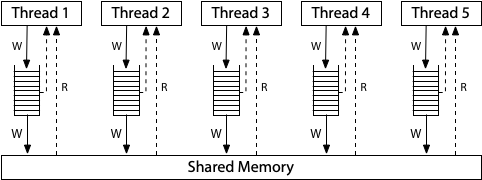
https://research.swtch.com/hwmm
Litmus Test: Write Queue (also called Store Buffer) Can this program see r1 = 0, r2 = 0?
// Thread 1           // Thread 2
x = 1                 y = 1
r1 = y                r2 = x
- On sequentially consistent hardware: no.
- On x86 (or other TSO): yes!
This example may seem artificial, but using two synchronization variables does happen in well-known synchronization algorithms, such as Dekker's algorithm or Peterson's algorithm, as well as ad hoc schemes. They break if one thread isn’t seeing all the writes from another.
kimi 的回忆
完成。新增 dekker.c —— 不加屏障的 Dekker 互斥锁,StoreLoad 乱序直接导致双方同时进入临界区:
┌─────────┬─────────────────────────────────┬─────────────────────────┐ │ 版本 │ x86 │ ARM │ ├─────────┼─────────────────────────────────┼─────────────────────────┤ │ nofence │ 7474 万/7474 万进入失效(~100%) │ 2.6 亿/3.1 亿失效(84%) │ ├─────────┼─────────────────────────────────┼─────────────────────────┤ │ fence │ 0/4645 万 │ 0/2.1 亿 │ └─────────┴─────────────────────────────────┴─────────────────────────┘
你听到的没错:StoreLoad 是 x86 TSO 唯一允许的乱序,前面的 sb.c 测的就是它;dekker 展示的是它的软件后果——互斥锁失效,效果更直观。
调试这个测试时踩了两个坑,都写进了 dekker.c 注释和 README:
• 检测代码自身也怕乱序:最初用 in_cs 计数判断双方同时在临界区,ARM fence 版本误报率 80%——退出方 in_cs=0 的 store 被排到 flag=0 之后可见,互斥 明明成立也会误报。记账代码两侧必须用无条件 dmb(不能跟着 FENCE() 宏走)。这本身就是”ARM 上共享变量通信都要考虑序”的活教材 • Apple Silicon 上真实乱序率太低:flag 分 cache line 时 ARM nofence 一次都测不到(和 sb 分线后只有 95/2909 万一致);让两个 flag 共享一条 line 加剧 ownership 争抢后才到 84%。这也解释了为什么这类 bug 在 ARM 上难复现但不代表不存在
README 的测试表格、两个架构的实测结果和解读都已更新,ARM 机器上的 ~/memory-model-tests/ 也同步了。
这个也可以整理了
https://zhuanlan.zhihu.com/p/41872203
TODO
我总是感觉这里的例子有点奇怪,每次启动一个 thread,真的就可以运气那么好,然后卡到一起吗?
本站所有文章转发 CSDN 将按侵权追究法律责任,其它情况随意。